
At a Glance:
- Space technology giant SpaceX officially priced its IPO at $135 per share to raise a record-breaking $75 billion dollars.
- The blockbuster listing values the newly integrated aerospace and artificial intelligence conglomerate at an unprecedented 1.75 trillion dollars.
- The massive capital influx positions founder Elon Musk to mathematically secure his status as the first verified trillionaire in global financial history.
- Major market indices establish an accelerated fast-track inclusion program to handle the immediate public trading debut under the ticker symbol SPCX.
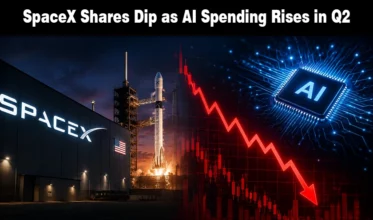
SpaceX has officially shattered global capital market records by pricing its historic initial public offering to raise $75 billion ahead of its public debut.
The unprecedented capital injection positions the aerospace company to expand its deep-space infrastructure much faster than its competitors. It also reshapes global wealth benchmarks, shifts institutional equity allocations, and drives major growth in technology and processing infrastructure.
SpaceX Raises $75 Billion
The transition from a privately funded venture to a public mega-cap marks a structural evolution for the global tech ecosystem as industrial capital demands reach historic levels.
According to CNBC, SpaceX raised $75 billion by offering about 555,555,555 shares at $135 each, surpassing the previous global listing record held by Saudi Aramco.
The leadership also granted underwriters an option to purchase up to 83.3 million additional shares, ensuring deep institutional liquidity for immediate market activity.
This business strategy bypasses traditional private funding rounds, giving SpaceX unrestricted access to public capital to finance orbital constellations and deep-space launch facilities on its own terms.
The move has also increased the value of legacy technical partnerships and long-term infrastructure commitments.
SpaceX IPO Redefines Market Value
The transaction requires a rethinking of corporate balance sheets, introducing secondary backing structures to manage multi-billion-dollar credit risks.
NPR data emphasizes that this market debut is a critical valuation test for capital markets, especially after the structural consolidation earlier this year when the SpaceX-xAI merger combined aerospace operations with advanced machine learning assets.
The IPO sets an initial public valuation of approximately $1.75 trillion, placing the company among the ten most valuable listed enterprises globally.
This valuation directly affects Elon Musk’s net worth, as his equity holdings and 82.4% voting power position him to become the first official trillionaire when public trading begins.
Analysts note that the listing anchors a trio of anticipated high-tech offerings, forcing public capital to adjust to a new standard for corporate operations. As institutional networks solidify, the IPO’s scale prompts adjustments across broader capital markets and portfolio allocations.
Analysts say the IPO anchors three upcoming high-tech offerings, guiding institutional capital across aerospace and AI. As networks stabilize, SpaceX’s debut is already affecting market valuations and portfolio strategies.
Market Rebalancing and Global Institutional Impact
The shift in multi-billion-dollar benchmarks creates ripple effects across regional equity desks and global portfolio allocations.
Immediate Market Reaction
Following the formal pricing of SpaceX’s record capital raise, index providers like Nasdaq and FTSE Russell introduced rapid rule changes to enable fast-track inclusion.
As a result, passive institutional funds and retirement asset managers are adjusting portfolios to absorb the roughly $1.75 trillion company, preparing large capital shifts from legacy technology holdings to meet required benchmark positions.
Sector-Wide Implications
The arrival of SpaceX as a trillion-dollar public company changes competitive dynamics across the aerospace and digital intelligence industries.
By setting a new valuation ceiling for deep tech, the debut increases scrutiny on rival rocket and software firms. Legacy defense contractors and AI ventures face pressure as asset managers favor SpaceX’s unique, vertically integrated supply chain over traditional capital structures.
Long-Term Product Consolidation
In the short term, developers face limited cluster controls and multi-tenant latency on shared networks.
In the long term, owning sovereign infrastructure allows bare-metal optimization and direct hardware control.
This predictability stabilizes engineering schedules, letting enterprise clients train generative AI models on confidential datasets in a fully isolated environment, eliminating data leaks and compliance risks.
Breakdown of the Listing Metrics and Capital Structure
This historic public listing forces a massive re-evaluation of market protocols.
What Changed:
The pricing of the 75 billion dollar offering officially transitions SpaceX from a closed private network into one of the largest publicly traded corporate entities in existence.
What Stakeholders Should Do:
Asset allocators must hedge regional grid exposure as local power demand rises.
Risk managers should structure multi-tiered energy contracts and audit hardware counterparties to protect capital from delivery delays and infrastructure bottlenecks in gigawatt-scale projects.
What to Avoid:
Enterprise officers must sidestep the assumption that standard public market oversight will instantly decelerate the company’s aggressive, high-risk development programs or alter its core long-term exploration goals.
Risk Factors: Regulatory and Governance Misconceptions
These critical realities debunk the most common misconceptions circulating Wall Street.
“Immediate Nasdaq exchange inclusion requires SpaceX to dissolve the existing dual-class super-voting structure.”
Regulatory rules allow founder shares to be retained, so the listing does not change internal control. The equity structure preserves near-total voting dominance for leadership, shielding the roadmap from short-term shareholder pressure or activist campaigns.
“Index providers will delay integrating the aerospace stock into global retirement portfolios for at least two fiscal quarters.”
Major index providers have not created a special fast-track inclusion protocol for this listing size. Passive funds and large mutual funds are only required to buy shares in line with standard index rules to avoid tracking errors against benchmarks.
Technical Verification Over Market Speculation
Based on global asset allocation shifts, long-term industrial value is driven by infrastructure strength and sovereign supply chains rather than speculation.
Public markets provide liquidity to scale hardware systems and orbital networks that private funding cannot sustain. Long-term leaders anchor financial structures to physical networks, converting public capital into operational capacity across global infrastructure systems.
What’s Your Take?
How will $75 billion in public capital affect timelines for independent satellite networks and global broadband?
Will institutional investors maintain equity if the company diverts large cash flows into speculative deep-space projects?
How This News Article Was Created
This business news analysis is exclusively based on:
- Official regulatory registration filings issued by SpaceX and the Securities and Exchange Commission.
- Primary financial analytics, market landscape reporting, and global index tracking data verified by CNBC and NPR.
- No internal investor files, private ledger books, or draft IPO prospectuses were accessed or altered beyond verified public reporting.
About Author

Ahmad in a nutshell is product of passion, enthusiasm and adventure. He loves to write around anything that involves behaviors, art, business and what makes people happier. He also shares his business and lifestyle content on entrepreneur.com and lifehack.org.